


Emergency Regulation on Applesnails
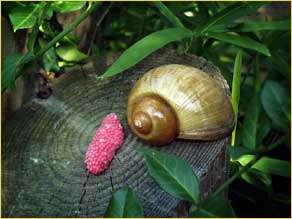
Applesnail & eggsac
Emergency Applesnail Regulation
On September 12, 2001, the Mississippi Department of Agriculture and Commerce – Bureau of Plant Industry adopted an Emergency Applesnail Regulation. This regulation was created to prevent the introduction and spread of destructive plant‑eating applesnails (family Ampullariidae) in Mississippi.
Under Sections 69‑24‑7, 69‑25‑9, 69‑25‑17, 69‑25‑19, 69‑25‑23, 69‑25‑25, and 69‑25‑35 of the Mississippi Code of 1972, the movement of any live applesnail—at any stage of development—into or within Mississippi is prohibited. This action is necessary to protect the state should applesnails be introduced.
Background on the Channeled Applesnail
Channeled applesnails were brought to Taiwan and the Philippines in the 1980s to be farmed for food. Some of these snails escaped or were released into the wild, spreading quickly. Today, they can be found from Indonesia to southern China and Japan.
The species was brought to Hawaii in 1989 for both food production and through pet‑trade releases. Instead of becoming a useful food source, the snails escaped into rice fields and became a major pest. They threaten rice production, damage taro plants, and harm the environment. Applesnails can also carry rat lungworm, a parasite that can infect humans.
These snails pose risks to ornamental plants, nursery crops, and many other plant species.
Applesnails in Mississippi
Applesnails have entered Mississippi mainly through the pet‑trade industry. They are medium to large aquatic snails with shells ranging from 2 to 6 inches tall. Pet stores often sell them as “mystery snails.” They come in several colors, including white, ivory, gold, and blue, and may be labeled as golden applesnails, gold mystery snails, ivory mystery snails, or black mystery snails.
The Bureau of Plant Industry has found applesnails in multiple pet stores across the state. We ask any store selling these snails to stop doing so and to destroy any remaining stock.
Protecting Mississippi’s Environment
The spread of applesnails around the world shows the risks of releasing non‑native species. This is why Mississippi has issued strict regulations on applesnail movement.
If you own applesnails, do not release them into ponds, lakes, streams, rivers, or drainage systems. Doing so can harm Mississippi’s environment and agriculture.
Contact
Plant Pest Program
Randy Boyle
PlantPest@mdac.ms.gov
P.O. Box 5207
Mississippi State, MS 39762
Phone: (662) 325-0878
Fax: (662) 325-8397